Service 01 · DevSecOps
Enterprise DevSecOps
environment setup
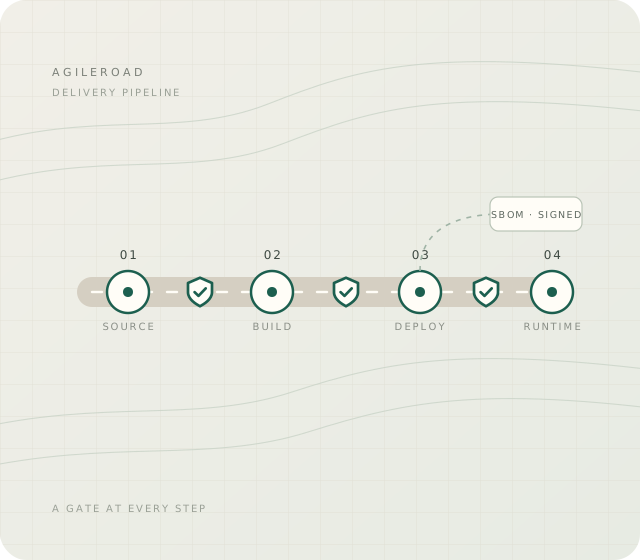
Security is not a check before release; it is a default action across commit, build, deploy and run. The goal is a process the team can maintain — not a set of tools only the consultant knows how to use.
01
Assessment and roadmap
Start with repositories, branching, CI/CD, registries, Kubernetes and the release process. Problems are sorted into "already doing", "missing" and "only on paper", then turned into a risk-ranked roadmap delivered in stages. No tool shopping first.
02
Pipeline and security gates
Add SAST, SCA, secret scanning and image scanning to your existing CI — GitLab CI, GitHub Actions or Jenkins. Gates separate blocking from advisory: new issues block, existing ones get a deadline, instead of a wall of red on day one.
03
Software supply chain
Generate and archive SBOMs, pin dependencies and base images, sign and verify images with cosign, and isolate build environments and registries. "Where did this image come from, and what built it?" becomes a question with an answer.
04
Infrastructure as code
Manage environments with Terraform, Helm and Kustomize; scan IaC with Checkov / tfsec; enforce policy as code with OPA / Gatekeeper / Kyverno. Environment differences live in code, not in someone's memory.
05
Kubernetes runtime
Least-privilege RBAC, NetworkPolicy segmentation, Pod Security Standards, external secrets (External Secrets / Vault), admission control and Falco runtime detection. The cluster goes from "it runs" to "we know who is running what".
06
Operations and handover
Set SLAs for vulnerability fixes; instrument gate pass rates and mean time to remediation; write an on-call runbook and rehearse a failure and rollback. Repositories, documentation and access are handed over together.